Bruce’s Annuity Calculator

A calculator for a stream of payments. Enter the payments and an interest rate and it gives their value today. Or enter the value and it solves for the payment, the rate or the length.

App Store Free, for iPhone and iPad
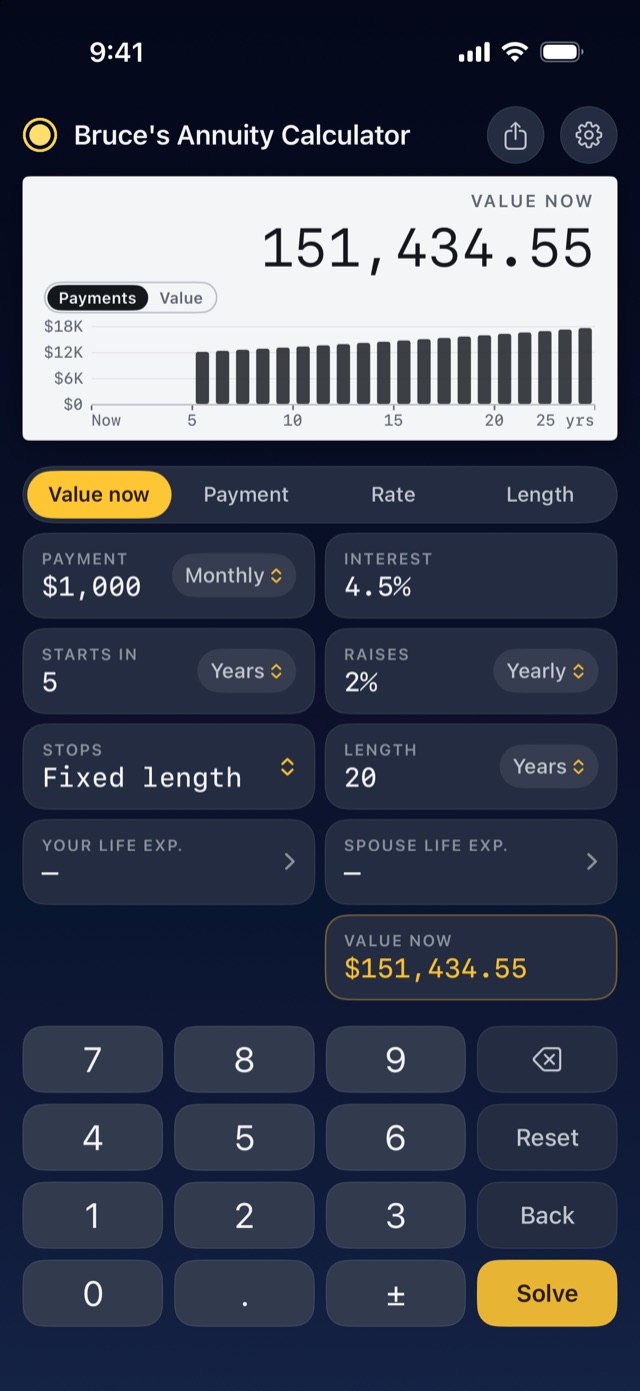
The calculator: $1,000 a month starting in 5 years, rising 2% a year for 20 years at 4.5% interest, is worth $151,434.55 today, with a bar for each year's payments.

What you enter

Everything is on one screen, under a display that updates as you type.

Payment
The amount, and how often: daily, weekly, every 2 weeks, monthly, quarterly, half-yearly or yearly. The ± key makes it negative, for payments you make rather than receive.
Interest
The rate each payment is discounted at, as an effective annual rate.
Starts in
Now, or after a wait.
Raises
A percentage or a dollar amount, from monthly to every 5 years. A negative raise makes the payments fall; falling dollar amounts stop at zero.
Stops
After a fixed length, at the end of your life, at the end of the second of two lives, or never.

The switch under the display chooses what to solve for: Value now, Payment, Rate or Length. The other three are inputs. For example, $1,000 a month starting in 5 years, rising 2% a year for 20 years, is worth $151,434.55 today at 4.5%. Switch to Rate and the same screen answers the reverse question: given a price, what rate do those payments return?
Payments for life

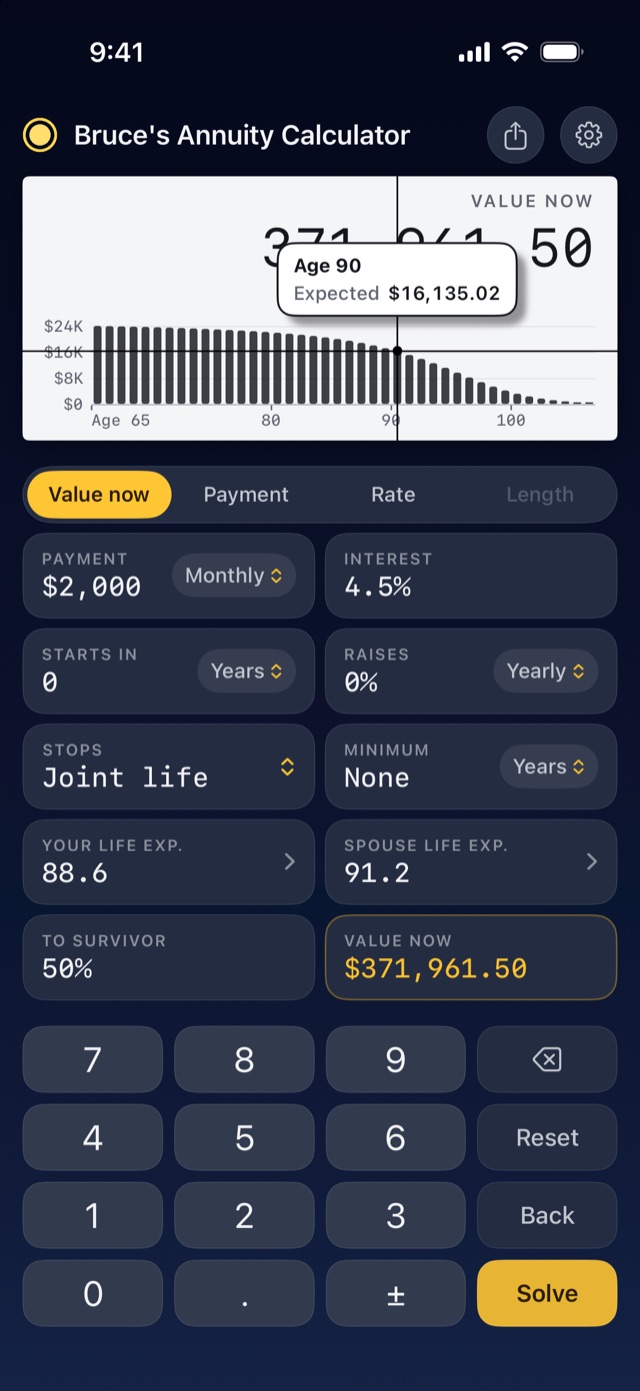
With Stops set to Your life or Joint life, each payment is weighted by the chance that someone is alive to receive it. Joint life pays while either of two people is alive, with the share you choose going to the survivor. A minimum period, if you set one, is paid either way.

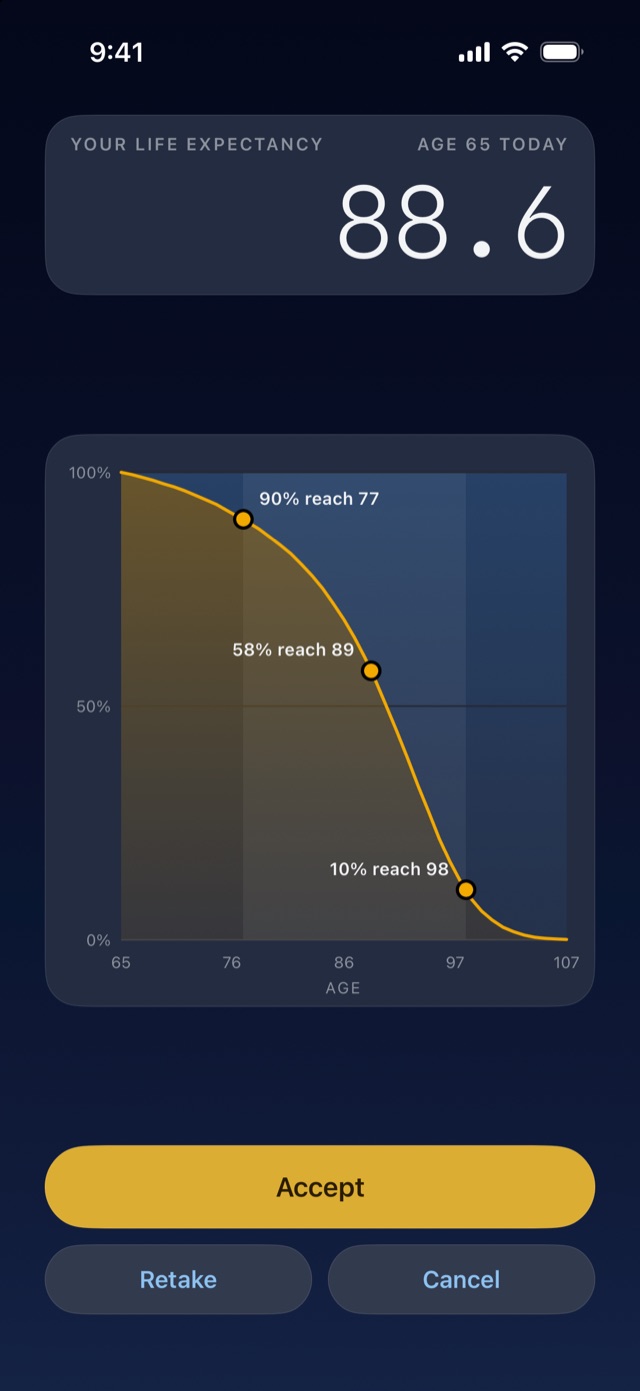
The life expectancies come from twelve questions about age, health and habits, one set for you and one for a spouse. Tap Your life exp. or Spouse life exp. to answer them. You can also answer them just to see the result: the last page shows the life expectancy and the chance of reaching each age.

Joint life: $2,000 a month while either of two people lives, half to the survivor, at 4.5%, is worth $371,961.50 today. A finger on the graph reads the expected payments at age 90: $16,135.02.
$2,000 a month for two lives, half to the survivor. A finger on the graph reads one year.
A life expectancy of 88.6 at age 65, with a curve of the chance of reaching each age: 90% reach 77, 58% reach 89, 10% reach 98.
The end of the twelve questions: 88.6 at age 65, and the chance of reaching each age.

The rest of the screen

The graph shows each year’s payments. Switch it to Value to see what the payments still to come are worth at the start of each year; for payments for life, that assumes the people are still alive then. Touch the graph to read any year.

The share button sends the answer as text: the result, the setup in one sentence and, for payments for life, the life expectancies it used. Back steps through your last 100 calculations, which are still there the next time you open the app.

How the numbers are made

A fixed stream is valued payment by payment, each discounted at the rate you enter. A length that is not a whole number of payments pays that fraction of the last one. Nothing is rounded until it reaches the screen.

A stream for life weights each payment by the chance someone is alive to receive it, starting from the exact age today. Those chances begin with Social Security and CDC life tables and actuarial mortality improvement research, adjusted for your answers by a model fitted on national health survey data (NHANES) linked to death records. The sources, with links, are in the app under Settings, About, How this works.

Your data

Everything is calculated on your device. Your calculations and answers are kept there so they are waiting next time, and Settings, Erase memory deletes them. There is no account and no sign in.

The app sends anonymous usage counts, including your answers in broad groups, but never your date of birth or an amount you enter. Settings, Collect anonymous data turns them off. The details are in the Privacy Policy.

The app is free, with no ads, no subscription and no in-app purchases. It was made by an actuary.